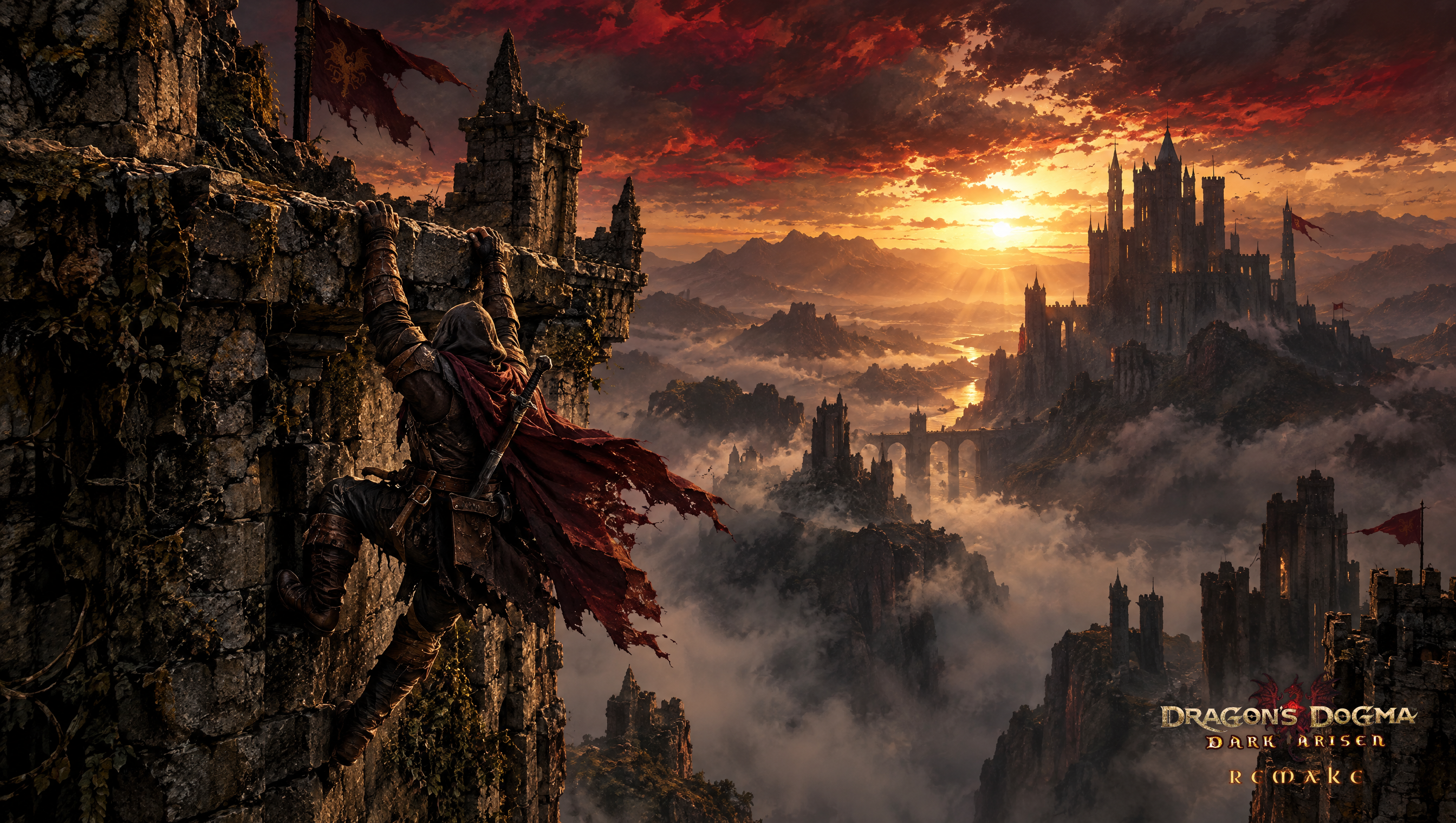
This was a big round. The Arisen can now grab ledges, fall badly, get back up, and plant their feet on uneven ground. The game also finally has a front door: a title screen, a main menu, an options screen, a loading screen, and a save system that keeps every save you make.
A playground to break things in
The default template level was replaced with a gray box playground built from code through the editor's scripting tools: ledge walls from 1 to 6 meters, a shimmy wall with a gap in it, drop towers at 2, 4, 8 and 16 meters, a gate wall with a walkway, a watchtower with an overhanging top, two plateaus joined by a narrow bridge, balance beams, stairs, and slopes at 20, 35 and 50 degrees. Every structure is there to test one mechanic.
Ledges, shimmying and hand IK
A new ledge component looks for a wall with a walkable top within hand reach while the character is falling. The first version only probed straight ahead at chest height, and playtesting found grabs that should have worked but didn't. Jumping into a wall kills your horizontal speed or slides it along the wall, so a single direction misses. It now probes where the player is steering, where the body is moving and where it faces, at four heights from the waist to above the head:
const float ProbeHeights[] = { 0.0f, HalfHeight * 0.5f, HalfHeight - 10.0f, HalfHeight + 30.0f };
for (const FVector& Direction : Directions)
{
    for (float ProbeHeight : ProbeHeights)
    {
        const FVector Probe = Location + FVector(0.0f, 0.0f, ProbeHeight);
        if (TraceLedge(Probe, Direction, Radius + GrabReach, CapsuleTop + GrabAboveCapsuleTop,
            CapsuleTop - GrabBelowCapsuleTop, OutLedgePoint, OutWallNormal))
        {
            return true;
        }
    }
}
While hanging, pushing toward the wall climbs up, pushing away lets go, and left or right shimmies as long as the edge continues. Hanging drains stamina, and at zero you drop. Two-bone IK on the arms projects each animated hand onto the edge line, so the hands grip the actual stone while the shimmy animation still moves them along it.
Feet on the ground
Foot IK runs in the same native animation code. The game thread traces under each foot, the pelvis drops to the lower foot, and each leg is solved so the foot lands on its own ground height and tilts to the slope. It fades out in the air and while hanging.
Falling like it should hurt
Fall damage follows the original's rules as closely as I could research them: damage starts around 5 meters, grows with the height dropped, ignores defense, and part of it becomes grey health that only rest restores. The drop is measured from the highest point of the fall, and catching a ledge resets it. Past 6 meters the body goes loose, with physics springs pulling the limbs toward a flailing animation. A damaging landing becomes a full ragdoll that carries the fall's momentum into the ground, and after a moment the character works out which way they are lying and plays the matching get-up. Falls from 20 meters or more are fatal.
Stamina polish
- Sprinting under a quarter of your stamina switches to a slower, ragged tired sprint instead of a full speed one.
- Running out mid-sprint now stumbles forward a few steps before doubling over. The first version froze in place because the speed cap dropped to zero at the same moment the coast started.
- Jumping out of a sprint costs extra stamina, and running dry mid-air waits until you land.
Title screen and main menu
The game now boots into a title screen with a looping video, the theme music, the logo, and "Press Any Key" (or "Press Start" with a gamepad plugged in). The menu layout follows the original: a stone band with a dragon emblem on the left, a translucent bar on the right that always holds the selected entry while the list scrolls through it, and a description box in the corner. It is built entirely in C++ with no widget Blueprints.
There is a small development tool in there too: T, Shift+T and Ctrl+T cycle through every menu sound for hover, confirm and back, so the right ones can be picked by ear in play.
Options and loading screen
The options screen has Gameplay, Graphics and Audio tabs. Graphics has quality presets (Auto, Performance, Low, Medium, High, Ultra) that flip to Custom when you change a single setting, a benchmark entry, and an estimated video memory bar measured against the card's real memory. Audio only offers 3D surround when the device is headphones or a home theater. It is UI only for now; the values will be wired in once there is a real scene to tune against.
The loading screen is a native Slate widget handed to the engine's movie player, so it keeps animating even while the map load hitches. It shows artwork, a random tip and a "Now Loading" line.
Saves: every one of them
Unlike the original's single save, this works like Skyrim. You can keep up to ten characters, so one playthrough can be a Fighter and another a Mystic Knight. Every save gets its own file and nothing is ever overwritten, so you can go back to the very first save hours later, experiment, and return to the latest. Autosaves happen when combat starts, a few seconds after it ends, and every 60 seconds outside combat, but never while falling, hanging or dead. Manual saves, quicksaves (F5) and a character's first save are kept forever, while autosaves keep the newest 50 per character so the timer doesn't fill the disk.
The save file is written in the background, and a small badge in the corner counts "Saving 0%" up to 100% as the real steps finish: the state is captured, the save list is written, and the background write reports back.
Next up
- Playtest all of the above and tune it.
- Pick the final menu sounds.
- Knockback and knockdown reactions when hit.
- Character creation, so New Game stops being "Arisen 1".